Logistics - First Class!
(904) 549-6950
The container has reached your facility, but the delivery plan determines what happens to the truck next…
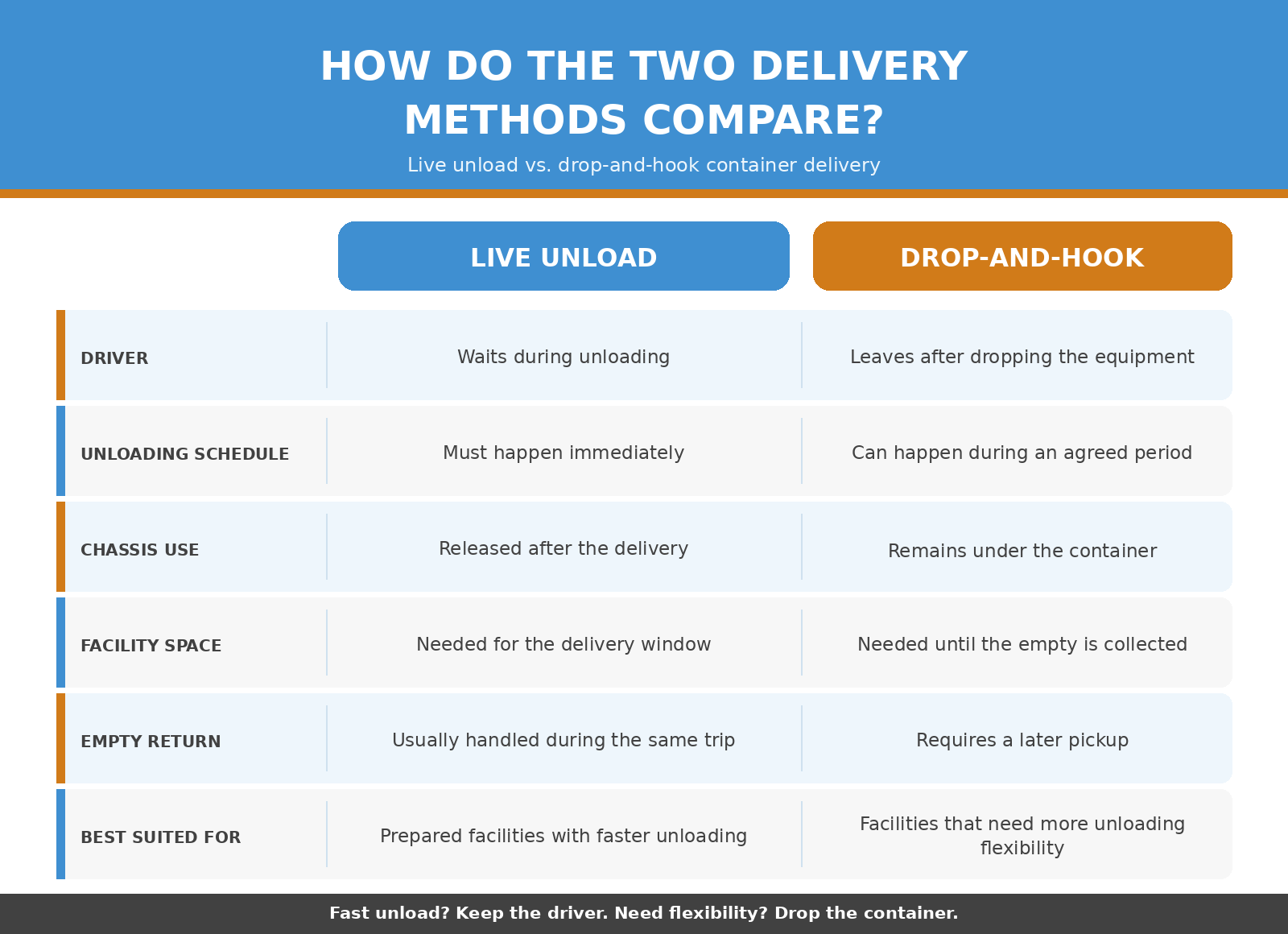
With a live unload, the driver waits while your team removes the cargo and then takes the empty container away. With a drop-and-hook delivery, the driver leaves the loaded container and chassis, connects to another piece of equipment when available, and departs. The empty container is collected later.
Neither method is automatically better. A live unload may work well when the receiving team can empty the container quickly. Drop-and-hook provides more unloading flexibility, but it requires space, chassis availability, and careful coordination for the empty return.
During a live unload, the driver remains at the receiving facility while employees unload the container. Once the cargo is removed, the driver transports the empty container to the designated terminal or depot.
A live unload keeps the container and chassis moving within a single trip. The customer does not need to store the equipment or schedule a separate pickup.
The arrangement works best when:
A 30-minute delay at the dock can quickly become a much longer wait if employees, forklifts, or loading areas are unavailable.
In standard trucking, drop-and-hook usually means leaving one trailer and connecting to another. Container drayage works a little differently because the ocean container sits on a separate chassis.
For a container delivery, the process may also be described as a drop-and-pick or drop-and-return. The driver leaves the loaded container on its chassis so the customer can unload it without the driver waiting. A later trip retrieves the empty equipment and returns the container to the location specified by the ocean carrier.
This option gives the receiving facility more time, but it temporarily ties up both the container and chassis.
A live unload is often the better choice when the receiver can empty the container within the time included in the transportation agreement.
Consider a distribution center receiving palletized retail products. The delivery has a confirmed appointment, an open dock, and a forklift team waiting. If the crew can unload the container promptly, keeping the driver on-site may be simpler than leaving the equipment and arranging another trip.
Live unloading can also be preferable when:
The main risk is driver waiting time. If unloading takes longer than expected, additional charges may apply according to the transportation agreement.
Drop-and-hook can help when unloading requires more time than a live appointment allows.
A floor-loaded container is a good example. Unlike palletized freight, individual cartons may have to be removed by hand, sorted, counted, and inspected. Holding the driver at the facility throughout that process may not make operational or financial sense.
Dropping the container allows the receiving team to work through the cargo according to its staffing and dock schedule.
This method may also be useful when:
The added flexibility comes with added responsibility. The receiver must protect the container and chassis, finish unloading within the agreed window, and notify the transportation provider when the empty is ready.
A drop delivery requires a chassis to remain under the container. If equipment is already limited, leaving a chassis at the customer’s facility may affect availability for other moves.
The shipper must also account for the empty return. Ocean carriers can change return locations or require the container to be returned to a specific terminal or depot. Delaying pickup after unloading may lead to additional equipment-use charges, depending on the applicable agreement.
Before scheduling a drop, confirm:
A drop should not become an open-ended storage arrangement.
Refrigerated containers require additional planning because the cargo may need power and temperature monitoring during unloading.
A live unload may reduce the time the container spends away from its transportation setup, but only if the facility can unload it promptly. A drop may provide more time, but the receiver must have an approved plan for maintaining power and protecting the cargo.
America 1 Logistics supports reefer container drayage and offers shore-power capabilities for staged refrigerated containers. Shipment requirements and equipment availability should be confirmed before pickup.
The best unloading method is the one that matches the facility’s actual capabilities.
America 1 Logistics provides intermodal drayage services for standard, reefer, overweight, rail, and HAZMAT containers across its Southeast network. Our team can help coordinate container pickup, delivery scheduling, secured storage, transloading, cross-docking, and continued transportation.
Contact America 1 Logistics with your container information, delivery location, cargo details, and unloading requirements to plan the right approach.
The included unloading time depends on the carrier’s rate confirmation or transportation agreement. Shippers should confirm the allowed time and possible waiting charges before the delivery appointment.
Yes. The facility needs a secure area where the loaded container and chassis can remain until unloading is complete and the equipment is collected.
The drayage provider typically retrieves the empty container and returns it to the carrier-designated terminal or depot. The shipper or receiver must communicate when unloading is complete so the return can be scheduled.